
India's Lab-Grown Diamond Exports in Numbers, 2022–23 to 2025–26
Four years of GJEPC figures tell a clear story: more lab-grown carats leave India every year, each one at a lower price, and more of them now leave set in gold jewellery.

Every April, the Gem & Jewellery Export Promotion Council (GJEPC) publishes India's export figures for the financial year just ended. For laboratory-grown diamonds, the last four years tell one consistent story: India ships more lab-grown carats every year, each one at a lower price, and a growing share now leaves the country already set in gold jewellery. Here are the numbers, and what they mean for buyers.

More carats than natural diamonds
In 2025-26 India exported 18.8 million carats of polished lab-grown diamonds against 16 million carats of polished natural diamonds. For an industry that cut almost only mined rough a decade ago, it is a striking shift, and most of those carats were cut and polished in Gujarat, around Surat.
Falling value, rising volume
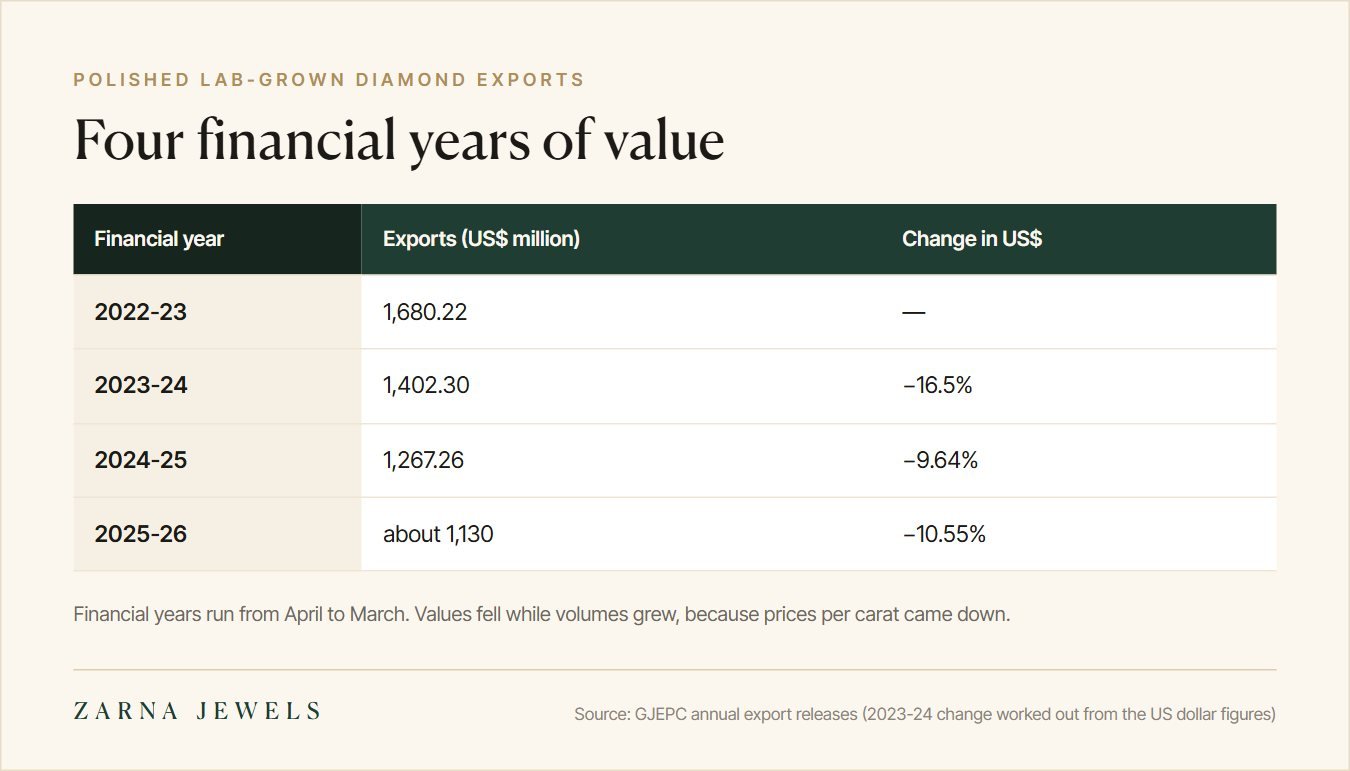
The value of polished lab-grown exports has fallen four years running, from about US$1.68 billion in 2022-23 to about US$1.13 billion in 2025-26. That is not a collapse in demand. Volumes rose while prices per carat fell, as growers in India and China added reactor capacity and growing became more efficient.
The quiet growth story: jewellery
The most interesting line in the 2025-26 figures is not the loose stones. Exports of gold jewellery set with lab-grown diamonds rose 31.3%, from about US$1.09 billion to US$1.43 billion. More of India's lab-grown output now leaves as finished pieces, earning the value of design, gold and craftsmanship rather than only the stone.
Where it goes: the markets in 2025-26
GJEPC's figures for all gem and jewellery exports, natural and lab-grown together, show how the destinations shifted in 2025-26, a year in which total exports dipped 3.3% to US$27.72 billion:
| Market | Gem & jewellery exports 2025-26 | Change |
|---|---|---|
| UAE | US$8.70 billion | +10.5% |
| USA | US$5.09 billion | −44.9% |
| UK | US$712 million | −8.5% |
| Australia | US$360 million | +38.3% |
| Canada | US$320 million | +115% |
The sharp fall to the USA follows the additional US tariffs on Indian goods in 2025–26 (see our note on US tariffs and Indian jewellery). GJEPC's chairman described the year as growth becoming "more broad-based and less dependent on a single market", with Australia and Canada among the fastest risers, helped in Australia's case by the duty-free access of the India–Australia trade agreement.
What it means for buyers
Shoppers
More choice and better value in lab-grown jewellery, much of it made in India, wherever you buy.
Jewellers
A deep supply base for melee and certified stones, and manufacturers ready to make finished pieces to your designs.
Brands
Rising demand for set jewellery opens room for private-label collections made in Surat.
Made in Surat: lab-grown tennis bracelets


Zarna Jewels is the jewellery brand of Sheladiya Diamond, part of this story since 1983: we cut and polish CVD diamonds in Surat and set them in our own workshop. Jewellers and retailers can buy loose stones through Zarna B2B; for importing, see our importing checklist.
How many lab-grown diamonds does India export?
In 2025-26, 18.8 million carats of polished lab-grown diamonds, according to GJEPC, worth about US$1.13 billion.
Does India export more lab-grown than natural diamonds?
By carat weight, yes: 18.8 million carats of lab-grown against 16 million carats of natural polished diamonds in 2025-26. By value, natural diamonds remain far larger.
Why did the value of lab-grown exports fall?
Prices per carat fell as production capacity grew, while the number of carats exported kept rising.


