
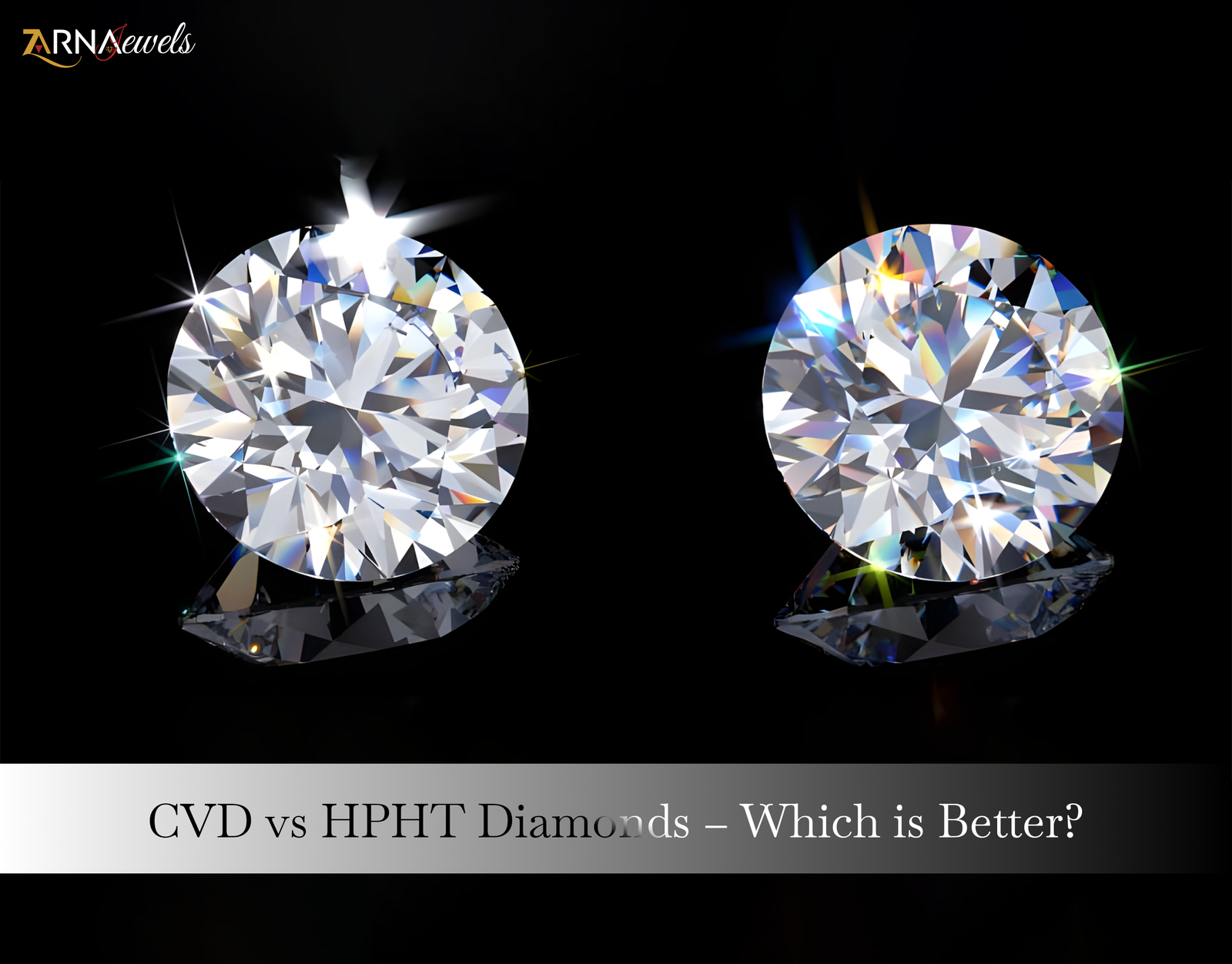
Two advanced methods dominate the industry:
-
CVD (Chemical Vapor Deposition)
-
HPHT (High Pressure High Temperature)
Both create real diamonds, but the processes and results differ. At Zarna Jewels, we specialize in CVD diamonds for their superior brilliance and eco-friendly production. In this blog, we’ll explore both methods, their pros and cons, and help you decide which is better for your jewelry.
🔬 The Science Behind Diamond Creation
⚙️ HPHT (High Pressure High Temperature)
HPHT was the first successful method to create lab-grown diamonds in the 1950s. It mimics how diamonds naturally form inside the Earth.
-
Process:
-
Carbon is placed inside a chamber with a small diamond seed.
-
Using extreme heat (1,500°C) and pressure (1.5 million PSI), carbon atoms bond and crystallize around the seed.
-
Over time, a diamond crystal forms.
-
-
Characteristics of HPHT Diamonds:
-
Often show yellow or brown tints due to nitrogen impurities.
-
Modern techniques have improved color, but many still require additional treatments to achieve a clear appearance.
-
Typically less expensive to produce, but the machinery consumes a lot of energy.
-
⚙️ CVD (Chemical Vapor Deposition)
CVD technology emerged later and is now considered the future of lab-grown diamonds.
-
Process:
-
A thin slice of diamond seed is placed in a sealed chamber.
-
Carbon-rich gases (like methane) are heated into plasma.
-
Carbon atoms deposit layer by layer on the seed crystal, forming a diamond.
-
-
Characteristics of CVD Diamonds:
-
Naturally more colorless and clear than HPHT.
-
Better control of impurities (nitrogen, boron).
-
Produces highly symmetrical diamonds with excellent brilliance and fire.
-
More energy-efficient compared to HPHT.
-
🆚 CVD vs HPHT: A Direct Comparison
| Feature | HPHT Diamonds | CVD Diamonds |
|---|---|---|
| Origin | First method, older technology | Modern, advanced technology |
| Color Quality | Often tinted (yellow/brown) | Naturally colorless to near-colorless |
| Clarity | May contain metallic inclusions | Fewer impurities, higher clarity |
| Energy Use | High energy consumption | More energy-efficient |
| Cost | Generally cheaper to produce | Slightly higher but better quality |
| Market Preference | Industrial use + lower-grade gems | Jewelry-grade, premium diamonds |
💍 Which Is Better for Jewelry?
When it comes to fine jewelry, customers want clarity, brilliance, and ethical assurance. That’s why CVD diamonds are preferred.
-
Zarna Jewels uses only CVD diamonds because they consistently offer:
-
Better sparkle and transparency.
-
Minimal inclusions.
-
Excellent quality grading from IGI & GIA.
-
HPHT diamonds still play a role in industry and technology (for tools, electronics, heat conductors), but for jewelry, CVD wins the crown.
🌍 Environmental & Ethical Impact
-
HPHT Diamonds: Require high energy, often powered by coal-heavy grids in producing countries.
-
CVD Diamonds: More sustainable, using less energy and often linked with renewable power sources.
For conscious buyers who value sustainability and eco-friendly practices, CVD diamonds are the clear choice.
✨ Celebrity & Market Trends
-
Many global jewelers, including brands in the USA, UK, Germany, and India, are switching to CVD diamonds.
-
Celebrities and millennials increasingly choose CVD for engagement rings, appreciating the blend of luxury + responsibility.
-
Analysts predict that by 2030, lab-grown diamonds could make up 20–30% of the diamond jewelry market, with CVD leading the way.
📖 Story: A Tale of Two Rings
Imagine you are choosing an engagement ring:
-
Ring A (HPHT Diamond): A beautiful stone, but slightly yellowish, and you later learn it needed color treatments.
-
Ring B (CVD Diamond): A brilliant, clear diamond certified by IGI, grown with less environmental impact.
Most couples today choose Ring B — because they want their love story to shine with purity, beauty, and sustainability.
🌐 Global Reach of Zarna Jewels
At Zarna Jewels, we craft all our jewelry with CVD diamonds and deliver worldwide:
-
USA 🇺🇸 | UK 🇬🇧 | Germany 🇩🇪 | Canada 🇨🇦 | Australia 🇦🇺 | India 🇮🇳 | Israel 🇮🇱
Every diamond comes with certification, secure packaging, and lifetime value.