
How Lab-Grown Diamonds Are Made: The CVD Process Step by Step
From a wafer-thin diamond seed to a polished, certified stone: the CVD growing process explained step by step by people who cut and polish laboratory-grown diamonds every day.

Chemical vapour deposition (CVD) grows diamond from a gas, one layer of carbon atoms at a time. It sounds like science fiction, and the equipment is high-tech, but the principle is simple. This is how it works, explained by a family business that cuts and polishes CVD diamonds in Surat, India.
In a nutshell
- A thin diamond "seed" sits in a vacuum chamber filled with hydrogen and a little methane.
- Microwaves turn the gas into plasma; carbon from the methane settles on the seed as diamond.
- Growth takes several weeks. The rough is then cut, polished and graded like any diamond.
The seed: diamond grows on diamond
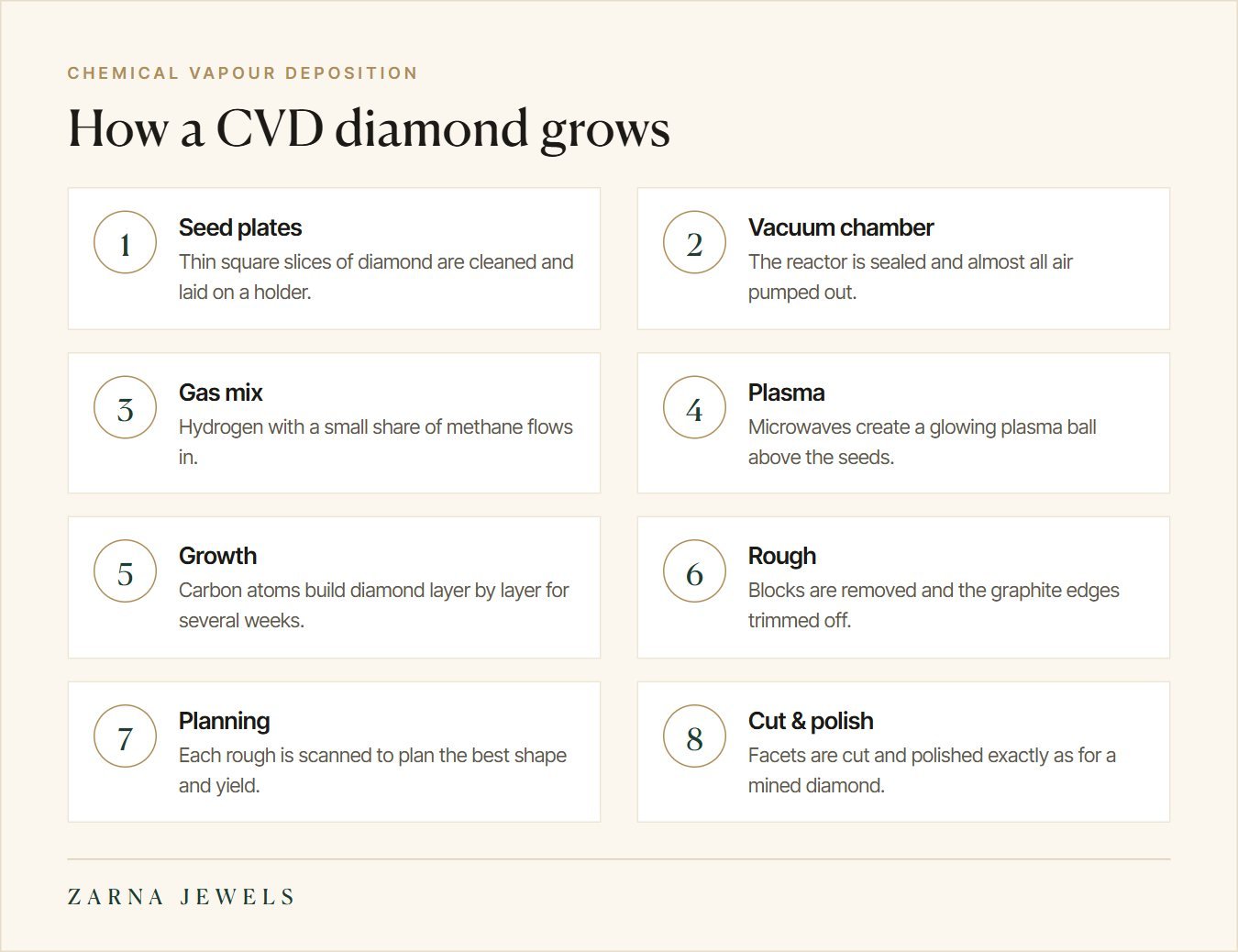
Every CVD diamond starts as a seed plate: a thin, flat square of diamond, often cut from an earlier CVD crystal. The seed gives the new carbon atoms a template to follow, so they build the same cubic crystal structure instead of turning into graphite or soot. The quality of the seed matters: defects in it can carry into the new growth.
The reactor and the plasma
Seeds are placed on a holder inside a sealed reactor. Pumps remove almost all the air, and a carefully controlled mix of hydrogen and a small proportion of methane (a carbon-containing gas) flows in. Microwave energy then excites the gas into a glowing ball of plasma just above the seeds, at temperatures typically in the region of 800 to 1,200 °C at the diamond surface.
In the plasma, methane molecules break apart. Carbon atoms land on the seed and bond into the diamond lattice, while hydrogen etches away any carbon that tries to form graphite instead. The result is a slow, steady build-up of diamond.
How long does it take?
Growth rates depend on the reactor, the gas recipe and the quality being aimed for. Faster growth tends to introduce more defects, so growers balance speed against quality. A block large enough to cut a one-carat stone typically spends several weeks in the reactor; at the growers we buy from, a cycle usually runs six to ten weeks from seed to rough.
From rough to polished diamond
- Trimming. The rough block comes out with a dark, graphite-rich rim, which is cut away.
- Scanning and planning. Each rough is mapped in 3D to find the shape and size that gives the best yield and appearance.
- Sawing and shaping. Lasers saw the rough and give it its basic outline.
- Faceting and polishing. Skilled cutters polish each facet on a rotating wheel, exactly as they would a mined diamond. This is where Surat, the world's diamond-cutting capital, comes in.
- Treatment if needed. Some CVD diamonds come out of the reactor with a brownish tint and receive a post-growth HPHT treatment to improve their colour. Reputable reports disclose it.
- Grading. An independent laboratory measures and grades the stone, confirms that it is laboratory-grown and laser-inscribes it.
What can go wrong?
Signs of a well-grown diamond
- Even colour across the stone
- Few or no visible inclusions
- Clean grading report with origin stated
Common growth problems
- Dark graphite inclusions
- Brownish tint needing treatment
- Strain or cracking from growing too fast
CVD and HPHT: two routes to the same material
The other main growing method, high pressure high temperature (HPHT), uses enormous presses instead of plasma. Both methods produce real diamond. We explain the differences in detail in our comparison of lab-grown and natural diamonds.
CVD diamonds, set by hand


Questions about growing diamonds
Are CVD diamonds real diamonds?
Yes. They are pure carbon with the same crystal structure, hardness and optical properties as mined diamonds. Only the origin differs.
How long does it take to grow a CVD diamond?
Several weeks. Growing cycles commonly run from about six to ten weeks, depending on the size and quality being grown.
Can a CVD diamond be coloured?
Yes. Adding small amounts of other elements during growth, or treating the diamond afterwards, can produce pink, blue or yellow diamonds.


