
How to Read a Diamond Grading Report, Line by Line
A grading report is dense with numbers and abbreviations. Here is what each line means, which ones matter most, and the details that quietly change how a diamond looks.

A diamond grading report can look like a lab printout, because it is one. But every line tells you something about how the stone will look and what it is worth. Here is how to read an IGI or GIA report line by line, and which details deserve most of your attention.
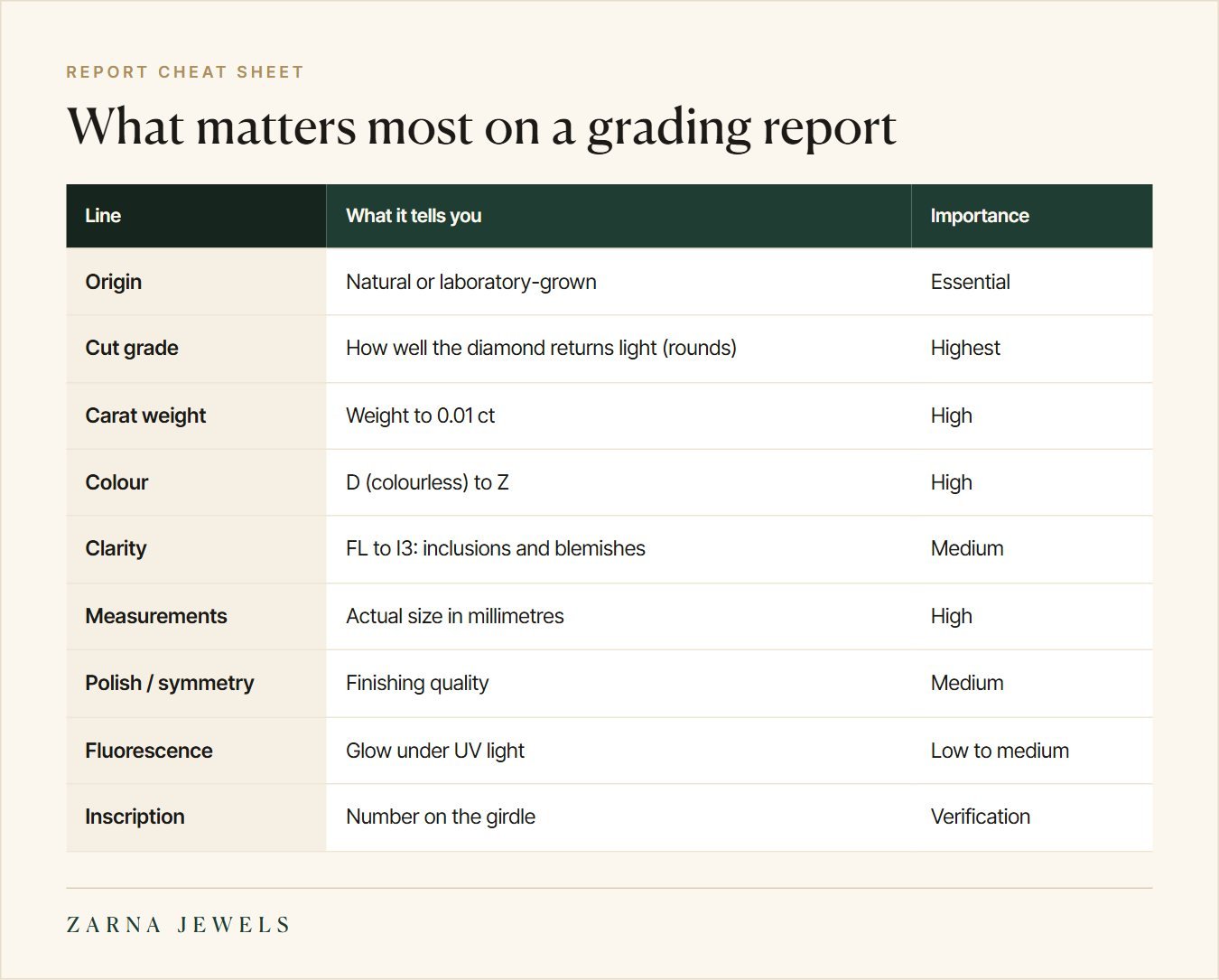
If you only check five things
- The origin: natural or laboratory-grown.
- The cut grade (for round diamonds) or proportions (for other shapes).
- The measurements, which show the real face-up size.
- Colour and clarity grades.
- That the report number matches the inscription and the lab's online record.
Report number, date and origin
At the top you will find the report number and issue date. Look the number up on the lab's website: the online record must match the paper. Near the top too is the statement of origin. A lab-grown diamond report says so clearly, often in the title ("Laboratory-Grown Diamond Report") and again in the comments. It may also mention the growth method (CVD or HPHT) and any post-growth treatment.
Shape, cutting style and measurements
"Round Brilliant", "Oval Modified Brilliant", "Emerald Cut" and so on. The measurements give length × width × depth in millimetres. For rounds, two diameters are shown (minimum and maximum); a big difference means a slightly out-of-round stone. Measurements tell you more about visible size than carat weight does.
The 4Cs
Carat weight
Given to two decimal places. Watch for "magic numbers": prices jump at 0.50, 0.70, 0.90 and 1.00 ct, so a 0.95 ct stone can look almost identical to a 1.00 ct at a lower price.
Colour grade
From D (colourless) to Z (light yellow or brown). D to F are colourless, G to J near-colourless. Most people cannot see the difference between neighbouring grades once a diamond is set.
Clarity grade
From Flawless (FL) through IF, VVS1, VVS2, VS1, VS2, SI1, SI2 to I1–I3. Many reports include a plot diagram showing where the inclusions are; an inclusion under a prong matters less than one in the middle of the table.
Cut grade
For round brilliants, labs give an overall cut grade (Excellent, Very Good, Good and so on, or "Ideal" on some IGI reports). It is the single biggest factor in sparkle. Fancy shapes usually have no overall cut grade, so look at the proportions instead.
Finish: polish and symmetry
Polish describes the smoothness of the facet surfaces; symmetry describes how precisely the facets are shaped and aligned. Excellent or Very Good for both is what you want in a centre stone.
Fluorescence
Some diamonds glow (usually blue) under ultraviolet light. Faint or none is the most common for lab-grown stones. Strong fluorescence can occasionally make a diamond look slightly hazy in sunlight, but in most stones it has no visible effect.
Proportions diagram
The profile diagram shows table %, depth %, crown and pavilion angles and girdle thickness. These numbers are what produce the cut grade. For fancy shapes, a table of roughly 53–63% and depth of roughly 58–66% (varies by shape) usually indicates a lively stone.
Inscription and comments
"Inscription(s)" shows what is laser-engraved on the girdle, normally the report number and, for lab-grown stones, words such as "LAB GROWN". The comments section lists anything else worth knowing, including treatments.
Certified centre stones


Is a diamond grading report the same as a valuation?
No. A report describes the stone's characteristics; it does not give a monetary value. Insurers usually want a separate valuation.
Do all lab-grown diamonds come with reports?
Not always, especially small stones. For any centre stone, ask for an independent report from a lab such as IGI or GIA.
What is the most important line on a report?
Origin first, then cut quality. A well-cut diamond with modest colour and clarity often looks better than a poorly cut stone with top grades.


