
10 Good Reasons to Choose a Lab-Grown Diamond, and 3 Reasons Not To

Six in ten engagement rings now have a lab-grown centre stone. Ten good reasons behind that, and three honest reasons a natural diamond might still be the better choice for you.
In The Knot's 2026 study, 61% of engagement ring centre stones were lab-grown, up from 52% a year earlier. That is a remarkable shift in a decade. Here are ten good reasons behind it, and, because a fair guide should say so, three reasons a natural diamond may still suit you better.
Ten reasons to choose lab-grown
- It is a real diamond. Same carbon crystal, same hardness of 10, same sparkle and fire. Only a laboratory can tell the difference. See is a lab-grown diamond real?
- More diamond for the money. The same budget buys a larger stone: in The Knot's study the average lab-grown centre stone was 2.0 ct against 1.6 ct for natural, at a lower average spend.
- Better grades within reach. D–F colour and VVS–VS clarity become realistic choices rather than stretches.
- Graded the same way. IGI and GIA grade lab-grown diamonds on the same 4Cs, and the report states the origin.
- A traceable origin. A grown diamond can be traced to the grower and the cutter; ours to the growers we buy from and our own workshop in Surat.
- No mining. No open pits or river dredging. Growing does use a lot of electricity, so ask about the energy source rather than assuming "green".
- Design freedom. Tennis bracelets, eternity bands and cluster designs that would be very costly with natural stones become everyday pieces.
- Every shape and many colours. Ovals, pears, emeralds and radiants, and colours such as pink, blue and yellow at sensible prices.
- Durable for daily wear. Same hardness and toughness as natural, so it is made for rings worn every day.
- Mainstream and trusted. Pandora, Signet's Kay and Zales, and Titan's beYon now sell lab-grown diamonds. See why the big brands went lab-grown.
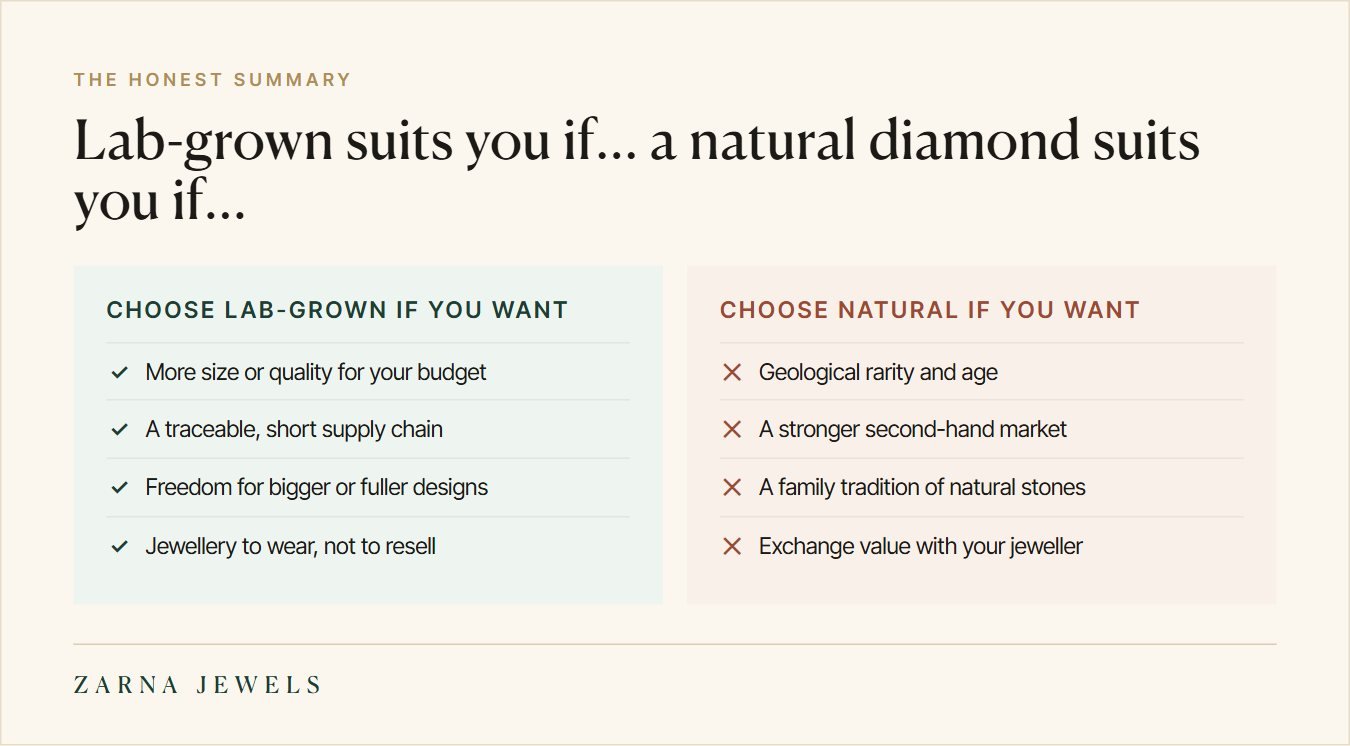
Three honest reasons not to
Resale
Lab-grown diamonds have a very limited second-hand market, and new-stone prices keep falling: India's lab-grown export value fell for four straight years while volumes rose. Buy one to wear, not to sell. More in our honest look at resale.
Rarity
If the idea of a stone formed a billion years ago, and the rarity that comes with it, matters to you, only a natural diamond gives you that.
Tradition and exchange
Some families, and some jewellers' exchange schemes, value natural diamonds only. If you expect to trade a piece in later, check first.
How to buy well, whichever you choose
- Get the origin in writing: natural or laboratory-grown.
- Insist on an independent grading report for any centre stone.
- Prioritise cut, then colour and clarity, then size.
- Check the report comments for treatment; see our note on as-grown and treated stones.
- Read the returns, resizing and warranty terms before paying.
Lab-grown halo rings from our workshop


Are lab-grown diamonds worth it?
For jewellery you will wear, yes: you get a real diamond with more size or quality for your budget. As a financial investment, no.
What is the biggest disadvantage of lab-grown diamonds?
Low resale value, because prices for new stones keep falling and the second-hand market is small.
Will people know my diamond is lab-grown?
Not by looking. Only laboratory equipment, or the report and girdle inscription, shows the origin.


